Domain-Based Message Authentication, Reporting, and Conformance (DMARC)
The Domain-Based Message Authentication, Reporting, and Conformance (DMARC) is a framework for ensuring proper application of SPF and DKIM, utilizing a policy published as a DNS record.
- DMARC policy is published as a DNS TXT record
- can use SPF or DKIM or both
- specifies an alignment mechanism to verify:
- that the domain identified in the rule header from field matches the domain in the envelope from field (return-path) in an SPF check
- and/or the domain component in a DKIM signature
- specifies a more robust policy mechanism for senders:
- to specify how DMARC authentication failures should be treated
- flag (
p=flag) - quarantine (
p=quarantine) - reject (
p=reject)
- flag (
- plus mechanisms for recipients to report DMARC authentication failures to the sender
- recipients can submit an aggregate report of failure statistics and a forensic report of specific message failures
- to specify how DMARC authentication failures should be treated
- provides reporting capabilities
- gives owner of a domain visibility into which systems are sending emails on their behalf
- including unauthorized activity
- gives owner of a domain visibility into which systems are sending emails on their behalf
- DMARC record includes:
p– policy indicating the requested action for an email that fails the DMARC check: reject, quarantine or nonepct– percentage of received emails to which the policy is to be appliedrua– address to which aggregate reports should be sentruf– address to which failure reports should be sent
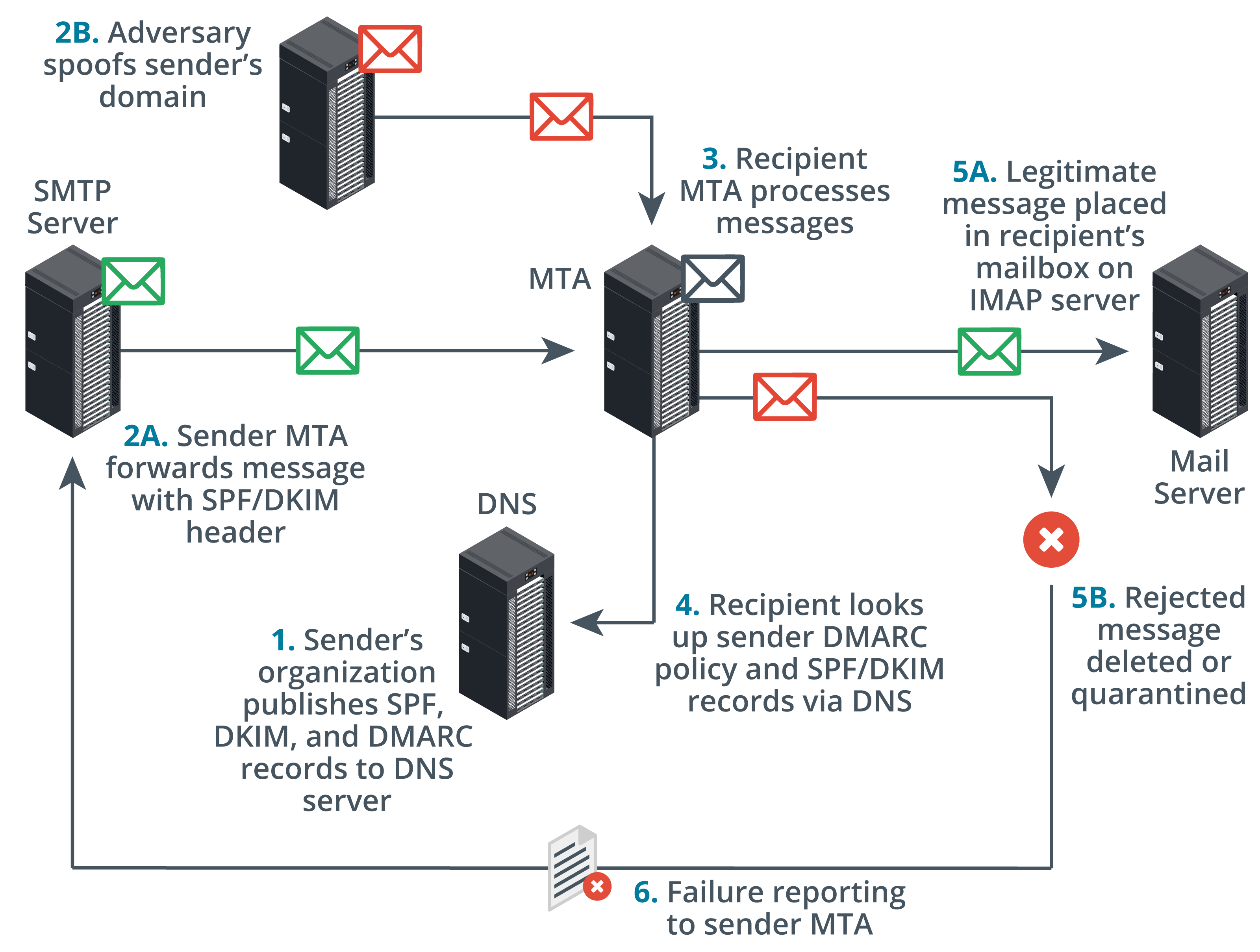
How it Works
DMARC
1 – Sender’s organization publishes SPF, DKIM, and DMARC records to DNS server.
2A – Sender MTA forwards message with SPF/DKIM header.
2B – Adversary spoofs sender’s domain.
3 – Recipient MTA processes messages.
4 – Recipient looks up sender DMARC policy and SPF/DKIM records via DNS.
5A – Legitimate message placed in recipient’s mailbox on IMAP server.
5B – Rejected message deleted or quarantined.
6 – Failure reporting to sender MTA.