Digital Certificates and PKI
- A smart card is programmed with:
- an encryption key pair
- and a digital certificate
- issued by the authenticating domain
- digital certificate is used to authenticate machines when using TLS
- certificate can be installed on a web server or email server to
- validate its identity
- establish a secure transmission channel
- certificate can be installed on a web server or email server to
- digital certificates depend on public key cryptography
- aka asymmetric encryption
- solves the problem of distributing encryption keys when you want to
- communicate securely with others
- authenticate a message that you send to others
- or authenticate yourself to an access control system
- generates a key pair
- private key remains a secret that only you know
- cannot be derived from the public key
- public key can be transmitted to other subjects
- used for:
- want others to send you confidential messages
- give them your public key to use to encrypt the message
- can then only be decrypted by your private key
- public key cannot be used to decrypt a message
- want to authenticate yourself to others
- create a signature using your private key
- give others your public key to use to verify the signature
- as only you know private key, everyone can assure that only you could have created the signature
- want others to send you confidential messages
- private key remains a secret that only you know
Info
- encryption using public key is slow
- rather than encrypting the whole message, typically encrypt a symmetric key
- for use in a single session
- called a session key
- exchanges it securely
- symmetric key is used to encrypt the message
- the basic problem with public key cryptography lies in proving the identity of the owner of a public key
- system is vulnerable to attacks where threat actor is able to substitute your public key for their own
- Public key infrastructure (PKI) aims to prove that the owners of public keys are who they say they are
Public Key Infrastructure (PKI)
Public key infrastructure (PKI) is a framework of certificate authorities, digital certificates, software, services, and other cryptographic components deployed for the purpose of validating subject identities.
-
anyone distributing public keys should obtain a digital certificate
- validity of the certificate is guaranteed by a certificate authority (CA)
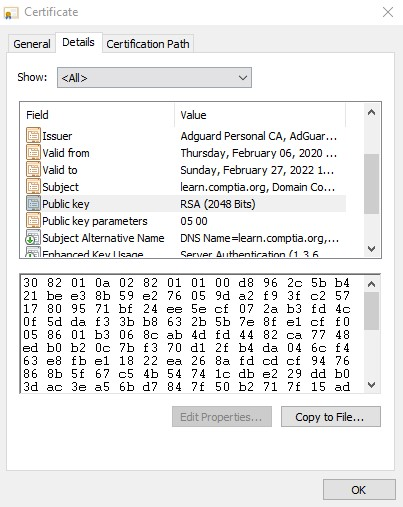
- is essentially a wrapper for a subject’s (or end entity’s) public key
- contains
- public key
- information about the subject
- info about the certificate’s issuer or guarantor
- digitally signed to prove that it was issued to the subject by a particular CA
-
sometimes, using PKI can be too difficult or expensive to manage
- Any machine, web server, or program code can be deployed with a self-signed certificate
- A digital certificate that has been signed by the entity that issued it, rather than by a CA
- e.g., web administrative interfaces of SOHO routers are often protected by a self-signed certificate
- can also be useful in development and test environments
- OS or browser will mark self-signed certificates as untrusted
- a user can choose to override this
- nature of self-signed certificates makes them very difficult to validate
- should not be used to protect critical hosts and applications
- Any machine, web server, or program code can be deployed with a self-signed certificate