Cross-Site Request Forgery (CSRF/XSRF)
Cross-site request forgery (CSRF/XSRF) is a malicious script hosted on the attacker’s site that can exploit a session started on another site in the same browser.
- aka confused deputy attack
- user and the user’s browser are not necessarily the same thing
- can exploit applications that use cookies to authenticate users and track sessions
- manipulates a logged-on user’s browser to send a forged HTTP request, cookies, and other auth info to force the victim’s browser to perform a malicious request
How it Works
- attacker must convince the victim to start a session with the target site
- attacker then must pass an HTTP request to the victim’s browser that spoofs an action on the target site
- e.g., changing a password or an email address
- the request could be disguised in a number of ways without the victim necessarily having to click a link
- e.g., as a image tag
- so could be accomplished without the victim necessarily having to click a link
- target site will accept the request as genuine if:
- assumes that the browser is authenticated
- i.e., there is a valid session cookie
- and doesn’t complete any additional authorization on attacker’s input
- or if the attacker is able to spoof the authorization
- assumes that the browser is authenticated
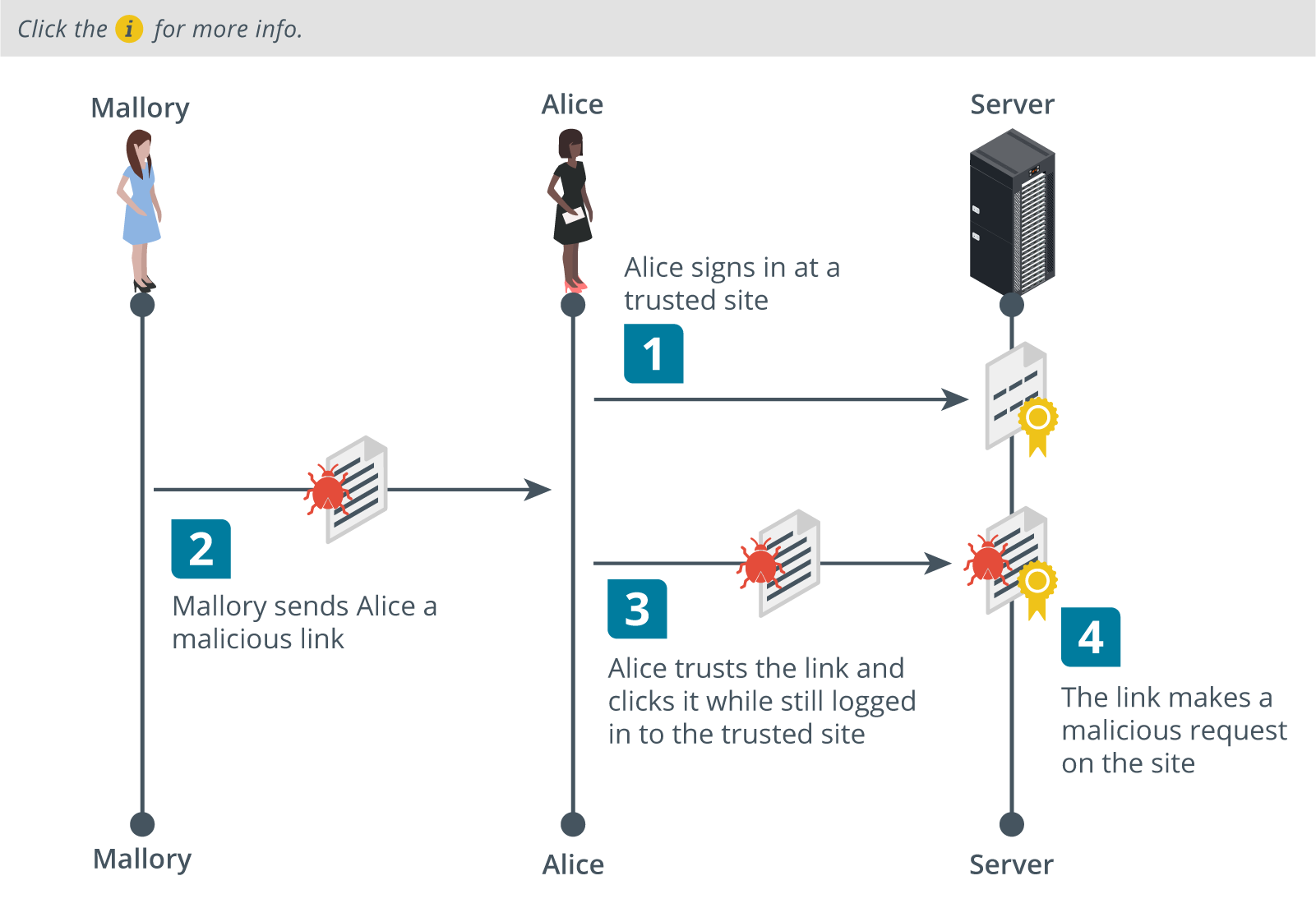
- if attacker knows a website has already authenticated a user,
- attacker can embed a link in a web page or HTML-based email to an image hosted from a site controlled by the attacker
- When the browser retrieves the image in the link, additional commands are executed
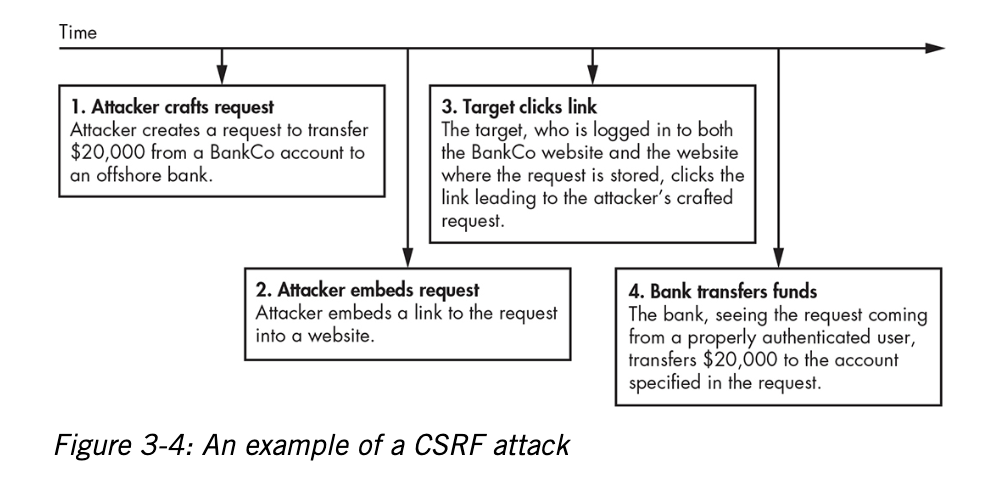
Example
Mitigation
- is extremely difficult
- the requests tend to look similar to those made by a user of a web application performing normal actions within the application itself
- request user-specific tokens in all form submissions
- When a web app generates a link or form that enables a user to submit a request
- the application should include a hidden input parameter with a common name such as XSRFToken
- value of this token must be randomly generated in a way that an attacker cannot guess it
- If the token can be guessed
- then either the algorithm or the implementation is flawed
- leaving the web app vulnerable to XSRF attacks