Classless Inter-Domain Routing (CIDR)
- classless addressing was designed to solve two major problems of classful addressing scheme:
- network addresses, specifically Class B, were becoming very scarce
- near exponential growth in Internet routing tables
- classless addressing
- supports subnetting
- can be used to summarize network prefixes and reduce complexity of Internet routing tables
Classless Inter-Domain Routing (CIDR) uses bits normally assigned to the network ID to mask the complexity of the subnet and host addressing scheme within that network.
- aka supernetting
Example
- rather than allocate a Class B (/16) network address to a company, several coniguous Class C (/24) addresses could be assigned
- Four /24 network addresses give 1,016 hosts
- this would mean complicated routing with many entries in the routing tables
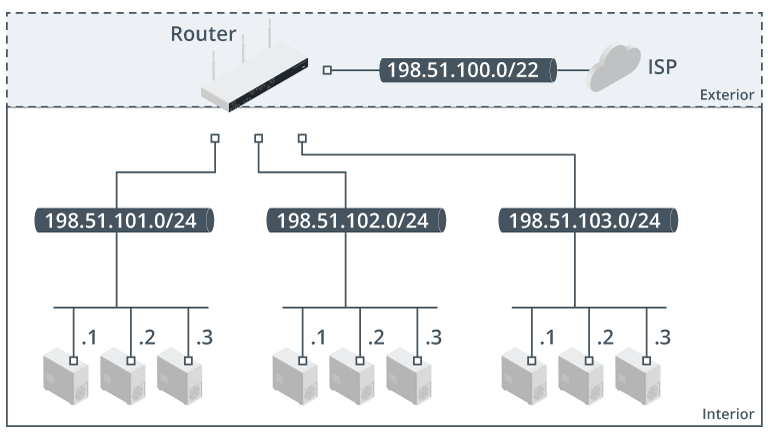
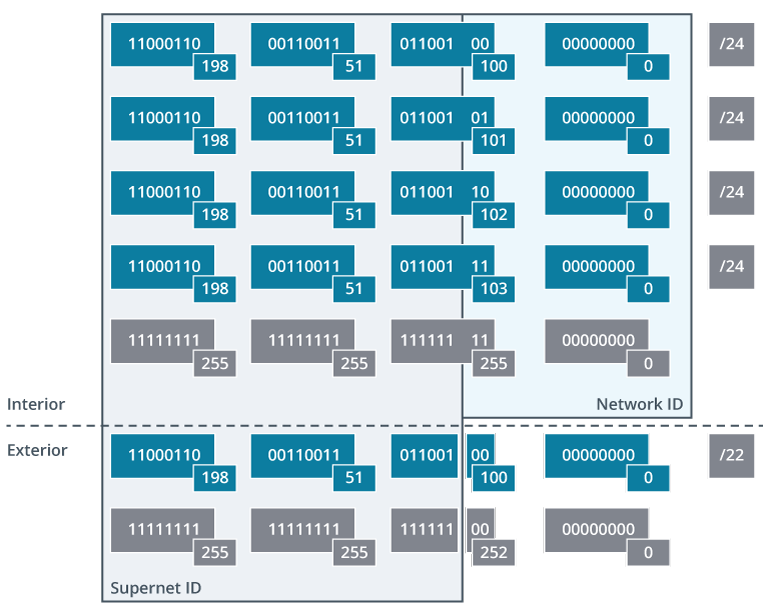
- represent 4 IP networks at same location
- Using CIDR:
- collapses these routing entries into one single entry
- E.g., if company has
198.51.100.0-198.51.103.0- to view as one network:
- need to allocate two bits from the network address to summarize the four networks
- makes the supernet prefix /22 or the subnet mask
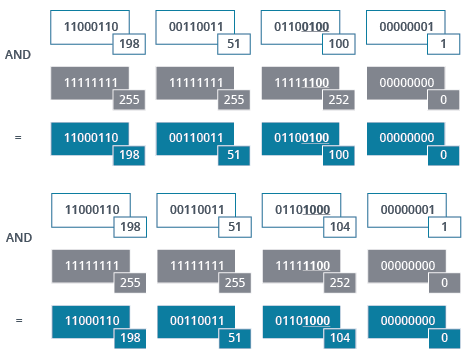
255.255.252.0- the ANDing process is used to determine whether to route
- if the ANDed result reveals the same network ID as the destination address
- then it is the same network
- First IP addresses belong to the supernet, but second is on a different company’s network
- Routers external to the network just use this /22 prefix
- so complexity of LAN subnets is hidden and doesn’t need to clog up routing tables
- LAN’s internal routers use the /24 prefix or multiple prefixes to create subnets of different sizes