Applying Normal Form
Normalization
- Occasionally, implementing entities, relationships, and attributes generates tables that contain redundancy
- this redundancy is eliminated with normalization
Normalization eliminates redundancy by decomposing a table into two or more tables in higher normal form.
- usually normalize to Boyce-Codd normal form
- if column A depends on column B, then B must be unique
- normalizing to Boyce-Codd normal form:
- List all unique columns
- unique columns can be simple or composite
- Composite columns must be minimal
- remove any columns that are not necessary for uniqueness
- Identify dependencies on non-unique columns
- non-unique columns are either
- external to all unique columns
- or contained within a composite unique column
- non-unique columns are either
- Eliminate dependencies on non-unique columns
- if column A depends on a non-unique column B, A is removed from the original table
- a new table is created containing A and B
- B is a primary key in the new table and a foreign key in the original table
- List all unique columns
Denormalization
- Boyce-Codd normal form is ideal for tables with frequent inserts, updates, and deletes
- reporting databases may contain tables that, by design, are not in third normal form
- changes are infrequent and redundancy is acceptable for reporting purposes
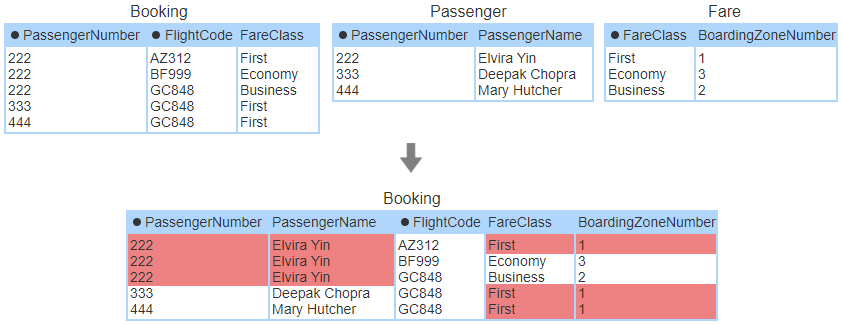
Denormalization means intentionally introducing redundancy by merging tables.
- eliminates join queries and therefore improves query performance
- results in first and second normal form tables
- should be applied selectively and cautiously
Denormalization Example
- Booking, Passenger, and Fare tables are denormalized into a single Booking table
- red highlight indicates redundancy
Database Design
- As tables and keys are specified, the database designer reviews each table for Boyce-Codd normal form
- Dependencies and unique columns are identified
- If any dependencies are not on unique columns,
- the table is decomposed into smaller tables in Boyce-Codd normal form
- Tables that experience infrequent inserts, updates, and deletes may be denormalized to simplify and accelerate join queries
Applying Normal Form
Step Activity 8A Identify dependencies on non-unique columns. 8B Eliminate redundancy by decomposing tables. 8C Consider denormalizing tables in reporting databases.