802.11b&g - 2.4 GHz Frequency Band
802.11b
IEEE 802.11b standard uses the 2.4 GHz frequency band and was released in parallel with 802.11a.
- standardized the use of:
- Direct Sequence Spread Spectrum (DSSS)
- a carrier method
- some ways inferior to OFDM (802.11a)
- support a nominal data rate of 11 Mbps
- Complementary Code Keying (CCK) signal encoding
- Direct Sequence Spread Spectrum (DSSS)
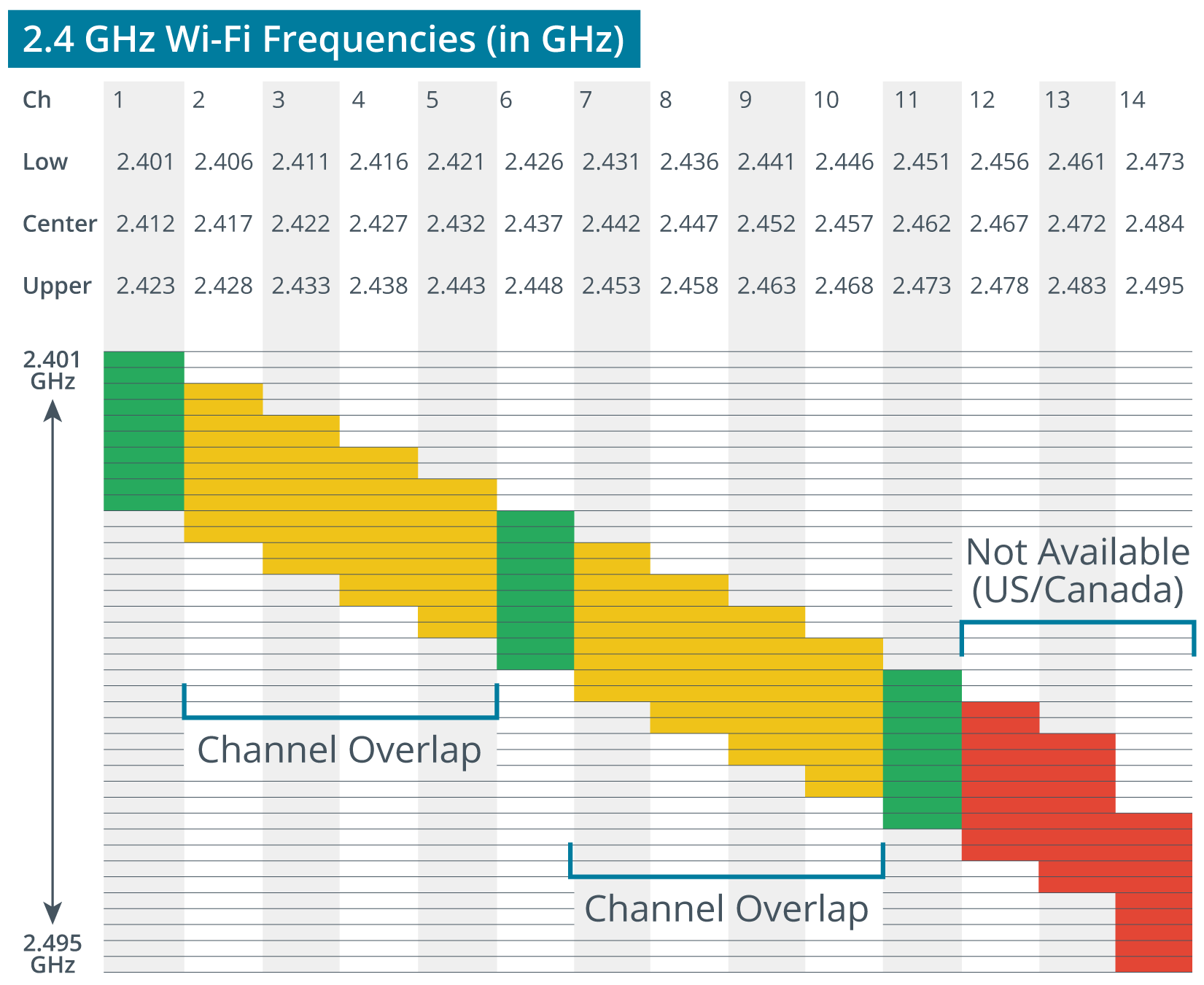
- 2.4 GHz band is subdivided into up to 14 channels
- spaced at 5 MHz intervals from 2,412 MHz up to 2,484 MHz
- Because the spacing is only 5 MHz and DSSS needs 20 MHz channel bandwidth, 802.11b channels overlap quite considerably
- means that co-channel interference is a real possibility
- unless widely spaced channels are chosen (1, 6, and 11, for instance)
- in the Americas, regulations permit the use of channels 1–11 only
- in Europe, channels 1–13 are permitted
- in Japan, all 14 channels are permitted
IEEE 802.11g
IEEE 802.11g standard offered a relatively straightforward upgrade path from 802.11b.
- uses the same encoding mechanism and 54 Mbps rate as 802.11a (OFDM)
- but in the 2.4 GHz band used by 802.11b and with the same channel layout
- made it straightforward for vendors to design 802.11g devices that could offer backwards support for legacy 802.11b clients
- when in 802.11b compatibility mode,
- drops back to used DSSS
Info
802.11b requires 22 MHz channels, but 802.11g only requires 20 MHz.
- The channel layout accommodates both standards
- If 802.11b compatibility is disabled, channels 1, 5, 9, and 13 are non-overlapping.