Types of Database Relationships
Cardinality describes how many possible occurrences of one entity can be associated with the number of occurrences in another.
One-to-One Relationships
One-to-one relationship is when one record in a table is associated with only one record in another table.
- primary key in the first table is often the primary key in the other table as well
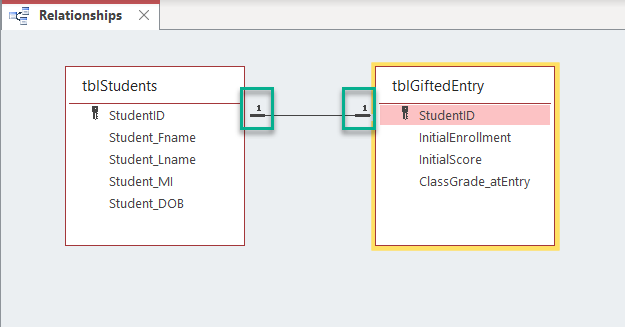
One-to-One Relationship in Microsoft Access
- symbols on the relationship line indicate the type of relationship that exists between these two tables
- can be only one record per student in tblStudents and only one record per student in tblGiftedEntry
- Thus, the cardinality of the two tables is a one-to-one relationship
One-to-Many Relationship
One-to-many relationship is when one record in a table is associated with multiple records in another table or tables.
- a primary key is joined to a foreign key
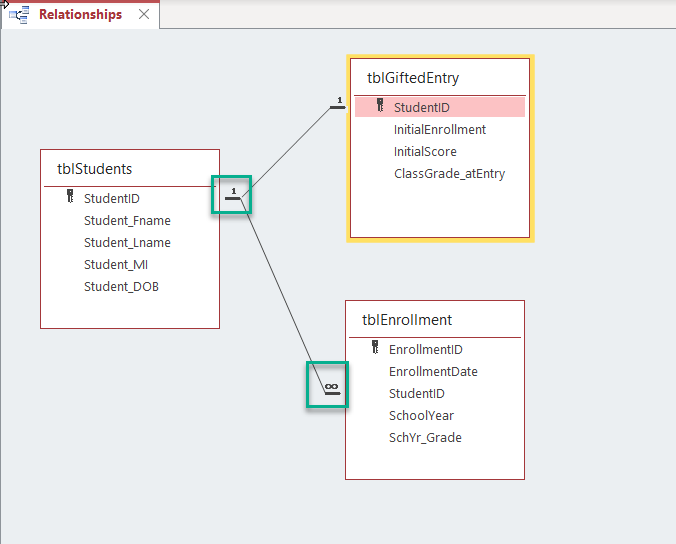
One-to-Many Relationship in Microsoft Access
- Each time our student enters into a new school year, we use their StudentID from the student information table to associate them to their new enrollment record for the year in the Enrollment table
- StudentID is a primary key in tblStudents but a foreign key in tblEnrollment
- establishes the one-to-many relationship
Many-to-Many Relationship
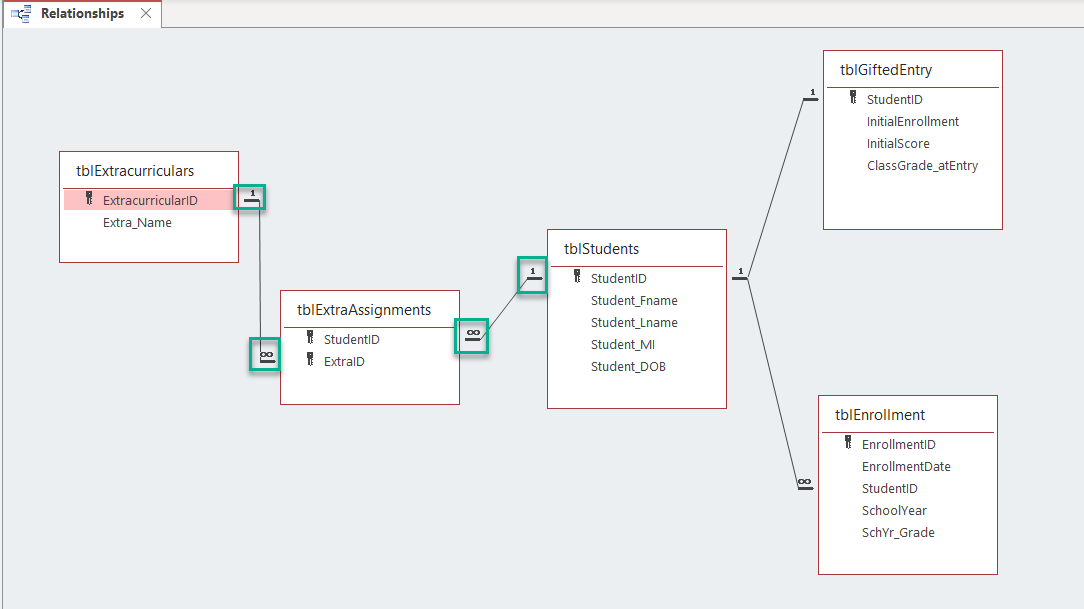
Many-to-many relationship is when many records in a table are associated to many other records in other tables.
- Data tools can’t resolve a many-to-many relationship without the use of another table that uses the associated keys from each table to serve as a bridge
- A bridge table is a table designed to “bridge” the many-to-many relationship
- performs as a one-to-many relationship with each of the tables that have many records in both tables
- typically, holds only key fields
Many-to-Many Relationship with a Bridge Table in Microsoft Access