Law of Diminishing Returns
The law of diminishing returns explains that growth is curved, not linear.
- is an economic principle, but can apply it to many scenarios
- Solution design uses diminishing returns to balance many requirements to create an optimal solution
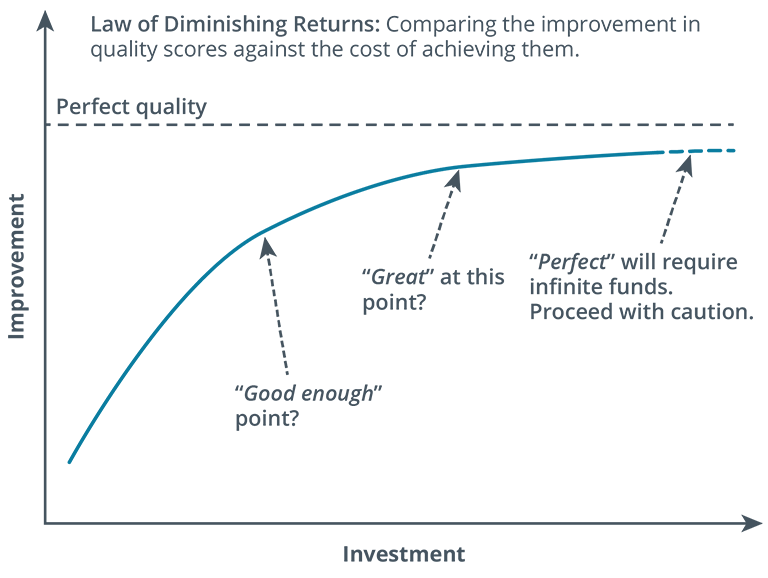
- graph explains a common phenomenon
- Productivity or value will improve sharply with a small initial investment
- but, every product, process, and system has a natural top limit
- trying to exceed that limit is extremely expensive
Example 1
- You are evaluating a process to determine how you can increase production and profit
- Right now, one person processes 50 goods per hour
- Translating this to money, assume labor costs $50 per hour
- Therefore, the current process cost is $1 per unit
- if one person can produce 50 goods per hour, four people should produce 200 goods per hour
- cost per unit would still be $1, and this would plot a simple linear graph
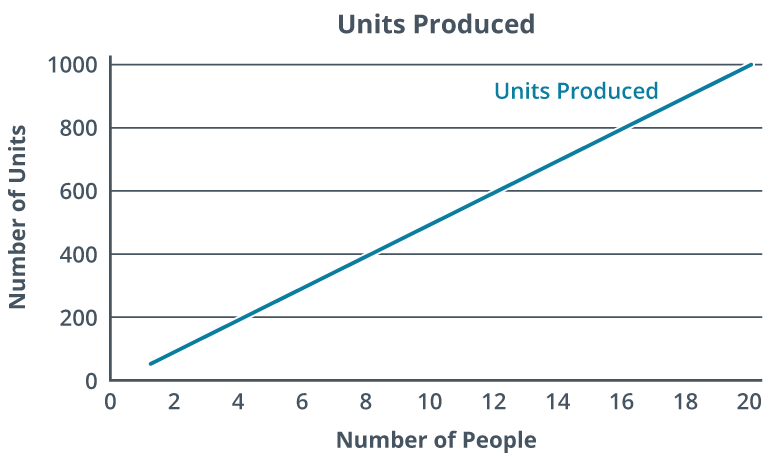
- But in reality, growth is not linear
- law of diminishing returns
- can use the law of diminishing returns to identify not the highest possible output but the highest profitable output
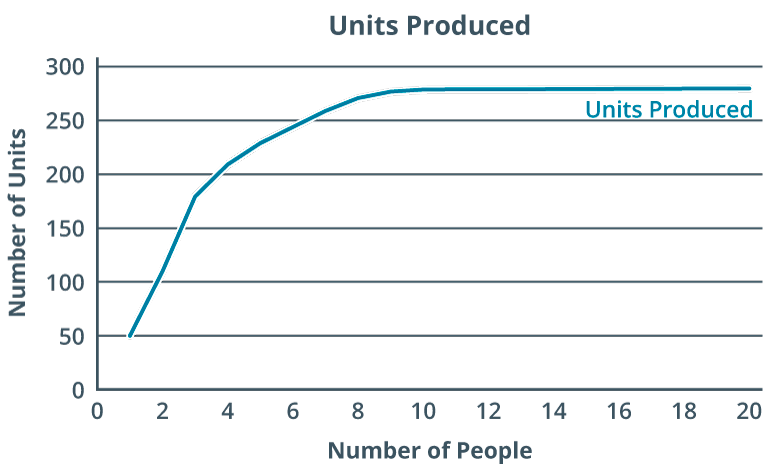
- Adding 2–3 people sharply increases growth
- production gains slow when four or more people work in the area
- system has other limitations, such as physical space, equipment, or demand