Conflict Resolution Strategies
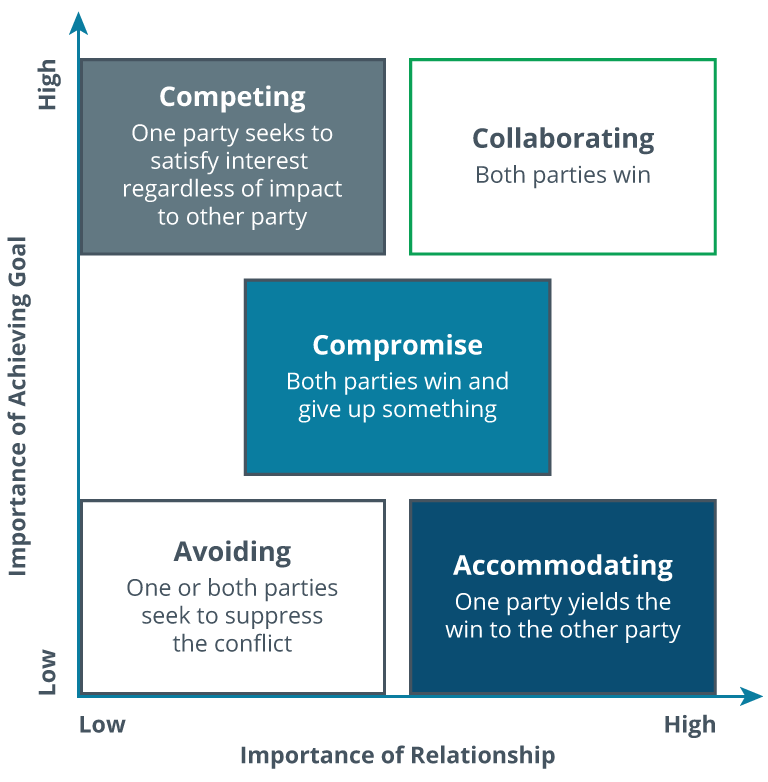
- manage and resolve conflict by applying five strategies:
- smoothing
- forcing
- compromising
- collaborating
- avoiding
Smoothing
Smoothing is a conflict resolution strategy that attempts to redirect focus away from the conflict by finding points of agreement.
- aka accommodating style
- attempts to redirect their attention away from the conflict
- refocus the parties on something they agree on while de-emphasizing any differences
- usually a temporary measure to ease tension and get parties to where they are ready to negotiate a solution
- Use a smoothing strategy
- when you need to de-escalate a conflict quickly
- to reduce friction temporarily while you look for a long-term resolution
Forcing
Forcing is a conflict resolution strategy that removes conflict by enforcing a solution.
- aka dominating style
- manage conflict by deciding what needs to happen to fix the issue
- can be a protective strategy
- Use a forcing strategy
- when you need to make a quick decision
- in an emergency
- to ease the strain of unpopular resolutions
Compromising
Compromising is a conflict resolution strategy that enables the parties to resolve conflict by meeting in the middle; everybody gives up something and retains something else.
- requires both parties to meet in the middle
- people in the conflict share their insights and concede to change something but keep some part of their idea
- Nobody gets everything they want, but they all receive something
- Use a compromising strategy when
- both parties are willing to give up something
- both arguments have merit
Collaborating
Collaborating is a conflict resolution strategy that enables parties to resolve conflict by designing a new solution that satisfies everybody.
- aka win-win situation
- parties in the conflict work together to design a new idea that works for everybody
- most complex approach and requires the most skill
- Use this approach when the conflict’s outcome is critical and both parties are invested in the outcome
Avoiding
Avoiding is a conflict resolution strategy that ignores a conflict or chooses not to address it.
- ignores the conflict
- choose this option if the problem is too small to address and isn’t affecting the team’s performance
- Use an avoiding resolution strategy when the issue isn’t hurting the team or resolving the issue won’t help the team