Agile Project Backlogs
A backlog is a prioritized list of requirements and functionality that could be added to a product or project; items at the top of the list are highly valuable, clearly defined, and ready for the agile team to begin delivering them.
- backlog owner continually refines and modifies the backlog
- items at the bottom of the backlog are not well defined, and they are clarified as they move towards the top
- A project backlog is slightly different from a product backlog
- PM creates a fixed start and end for project backlogs
- product owner fills a product backlog as long as the product is active
- backlog breaks down into epics, features, and user stories
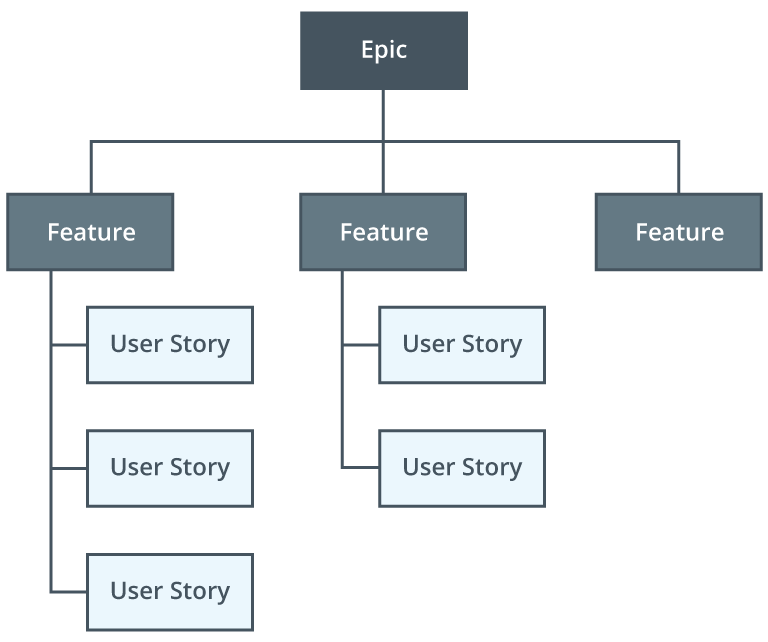
Epic
An epic is deliverable in an agile team that is equivalent in size to a project; often lasts several iterations or several months.
- large deliverable often triggered by a business case
- Compared to a WBS, an epic is equivalent to the project at level 1
- usually last a few iterations but could last for months
- break an epic into multiple features for planning and implementation,
Feature
A feature, in agile development, is a sizeable piece of functionality that is larger than a user story and smaller than an epic.
- Epics are broken into multiple features, which are then refined into multiple user stories
- usually lasts 1–3 iterations
- a completed feature should deliver a standalone deliverable that supports the epic
- equivalent of the Level 2 elements in a WBS
- too broad to deliver directly; therefore, teams split them into user stories
User Story
A user story, in Agile methodology, is the customer requirements or features.
- smallest agile deliverable
- equivalent to a work package in WBS
- does not describe how to do something, but it describes the expected outcome of completing the story
- estimate the size of user stories by relative effort or duration
- small enough that the team can complete it within one iteration
- stories should last 2–3 days because it keeps work flowing through their system