Agile Methodology
Agile is a software development model that focuses on iterative and incremental development to account for evolving requirements and expectations.
Agile methods are system development methodologies that propose incremental implementations, respond to rapidly changing requirements, and reduce the emphasis on rigorous requirements.
- E.g., Scrum and extreme programing
- rooted in the Manifesto for Agile Software Development
- 4 basic premises:
- Individuals and interactions are more important than processes and tools
- Working software is preferable to comprehensive documentation
- Customer collaboration replaces contract negotiation
- Responding to change is key, rather than following a plan
- 4 basic premises:
- tends to break work up into smaller units
- done more quickly and with less up-front planning
- focuses on adapting to needs rather than predicting them
- major milestones are subject to change as project advances
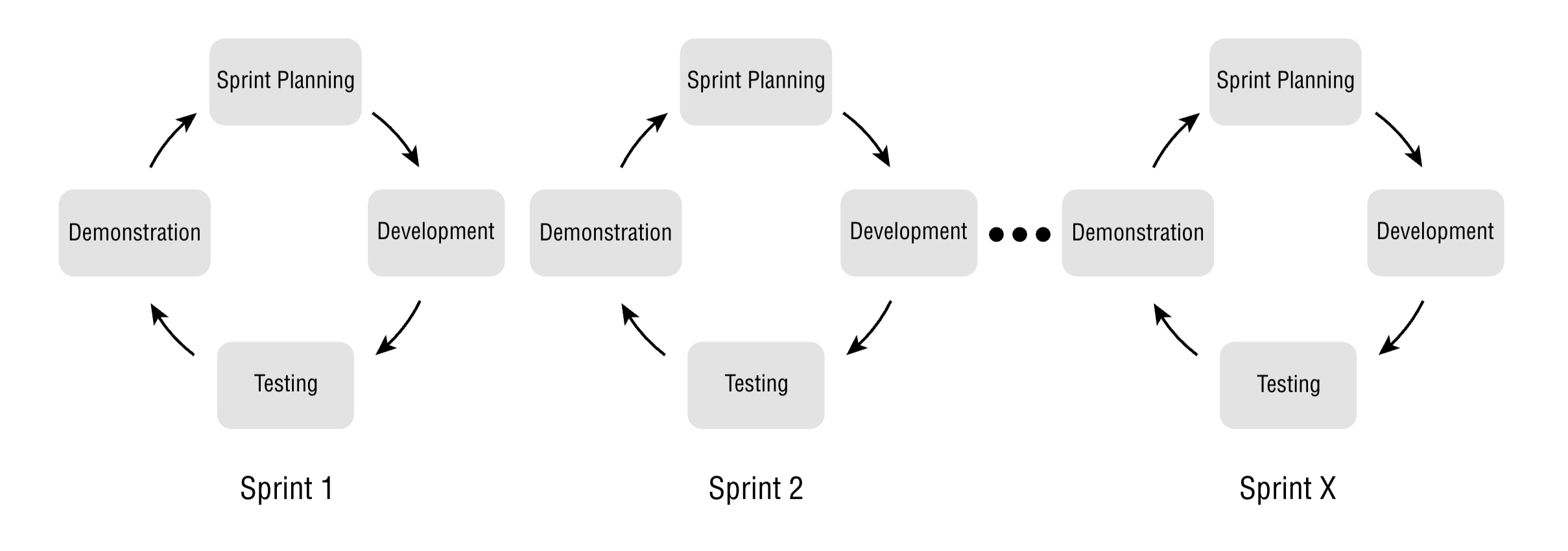
- work is broken up into short working sessions
- called sprints
- can last days to a few weeks
12 Agile Principles
- Ensure customer satisfaction via early and continuous delivery of software
- Welcome changing requirements, even late into the development process
- Deliver working software frequently (in weeks rather than months)
- Ensure daily cooperation between developers and business people
- Projects should be built around motivated individuals who get the support, trust, and environment they need to succeed
- Face-to-face conversations are the most efficient way to convey information inside the development team
- Progress is measured by having working software
- Development should be done at a sustainable pace that can be maintained on an ongoing basis
- Pay continuous attention to technical excellence and good design
- Simplicity—the art of maximizing the amount of work not done—is essential
- The best architectures, requirements, and designs emerge from self-organizing teams
- Teams should reflect on how to become more effective and then implement that behavior at regular intervals
Iterative vs Incremental Development
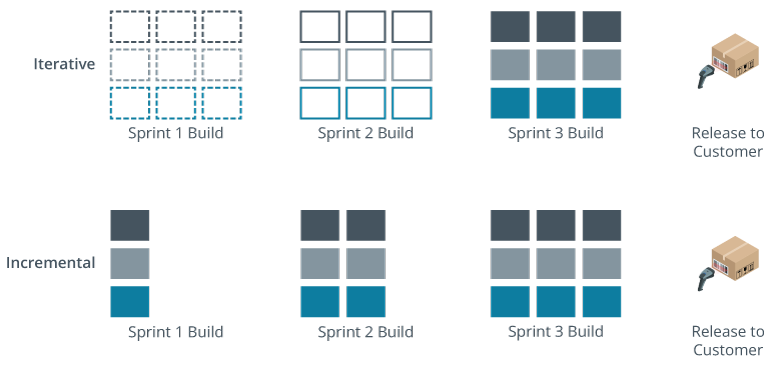
Iterative development is a process by which product development, such as software development, is broken down from a large application into smaller chunks. A product or product component is designed, developed, and tested in repeated cycles.
- refers to the cycle of improvement
- Something is built, inspected, and improved upon in the next iteration
- don’t focus on one component at a time
- e.g., work on small portions of the spending summary, color scheme, and category structures in one iteration
- receive feedback at the end of the iteration and improve each feature the next time they work on it
Incremental development is an approach that breaks the software development process down into small, manageable portions known as “increments.” Each increment builds on the previous version so that improvements are made step by step.
- means features are completed and released often throughout the project
- build all of one of the features and release it
- e.g., develop and release the spending summary and not work on the color scheme or category structures
Iterative and incremental development (IID) is a method that builds an incremental model that is developed in multiple cycles of iterations. A product may begin with relatively small components or steps, and incremental milestones are made during each cycle of the iterations until the final product is achieved.
- build one feature at a time and also build small sections at a time, review their progress, and adapt their approach
- release the feature to production only when it is appropriate
- e.g., know that the end feature should allow users to filter on multiple categories
- first iteration, they built something that moves toward the end goal
- then inspected it and realized this would be difficult to use if the user had many categories
- decide to develop a search feature in the next iteration
- team doesn’t release it to production in the first iteration
- feature is released when it makes sense
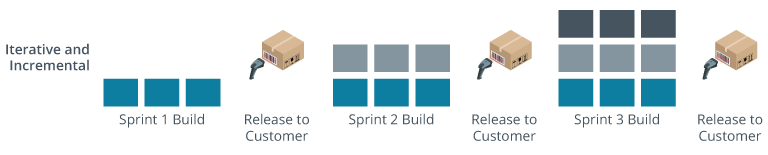
- agile frameworks use both iterative and incremental approaches
Specialized Agile Terms
- Backlogs are lists of features or tasks that are required to complete a project
- Sprint retrospective are held at the end of sprints to discuss what went well and what didn’t and what can be improved for the next sprint
- Planning poker is a tool for estimation and planning used in Agile development processes
- estimators are given cards with values for the amount of work required for a task
- estimators are asked to estimate, and each reveals their “bid” on the task
- this is done until agreement is reached
- goal is to have estimators reach the same estimate through discussion
- Timeboxing describes the use of timeboxes, which is a previously agreed-upon time that a person or team uses to work on a specific goal
- limits time to work on a goal to the timeboxed time
- rather than until completion
- once over, the work is assessed to see what should occur next
- limits time to work on a goal to the timeboxed time
- User stories are collected to describe high-level user requirements
- Velocity tracking is conducted by adding up the estimates for the current sprint’s effort and then comparing to what was completed
- tells the team if they are on track
Strengths of Agile
- great for uncertain environments with quite a bit of expected change
- promotes more testing and adjustments early on
- typically produces higher-quality results
- teams have increased autonomy
- end-users receiving greater value early and often
Weaknesses of Agile
- changing requirements can make a project’s end seem like a moving target
- flexibility can lead to scope creep and missed deadlines
- iterative and incremental designs are complex
- rely on stable and highly skilled teams
- can lead to less documentation
Use Cases for Agile
- Ideal for:
- Projects where requirements will change or emerge throughout the project
- Stable, skilled teams capable of self-organization
- Not suitable for:
- Short, simple projects that fit in a single iteration and increment
- overhead of agile frameworks isn’t valuable if the team does not have time to inspect and adapt the product
- Short, simple projects that fit in a single iteration and increment